

Asking the Right Questions: A Data-Informed Path to Unlocking Student Potential

Mary Ann Hudziak • September 29, 2026

Share this article

Key Takeaways:

  • Beyond High Achievement: True giftedness encompasses potential in leadership, creativity, artistic expression, and academic depth – not just high grades or compliant behavior.
  • Uncovering Masked Strengths: Standard testing often misses twice-exceptional (2e) students, English language learners, and underrepresented talent; multi-faceted data acts as an equalizer.
  • Balanced Data Collection: Pairing quantitative metrics with qualitative observations provides a comprehensive student profile without relying on a single test score.
  • Actionable Resources: Tools like the Wisconsin DPI's Targeted Screeners offer a structured path to match the right assessment to specific student domains.

Every classroom includes students whose true capabilities lie just beneath the surface, waiting not for harder work, but for the right questions to reveal them.


As the school year settles into its rhythm, educators naturally begin reflecting on the unique learners before them. To build a truly well-rounded profile of our students, we need to venture beyond the traditional fourth question of DuFour's PLC framework ("How will we extend the learning for students who are already proficient?"). Instead of viewing giftedness as a finished product, we can approach it as a landscape of potential waiting to be mapped.


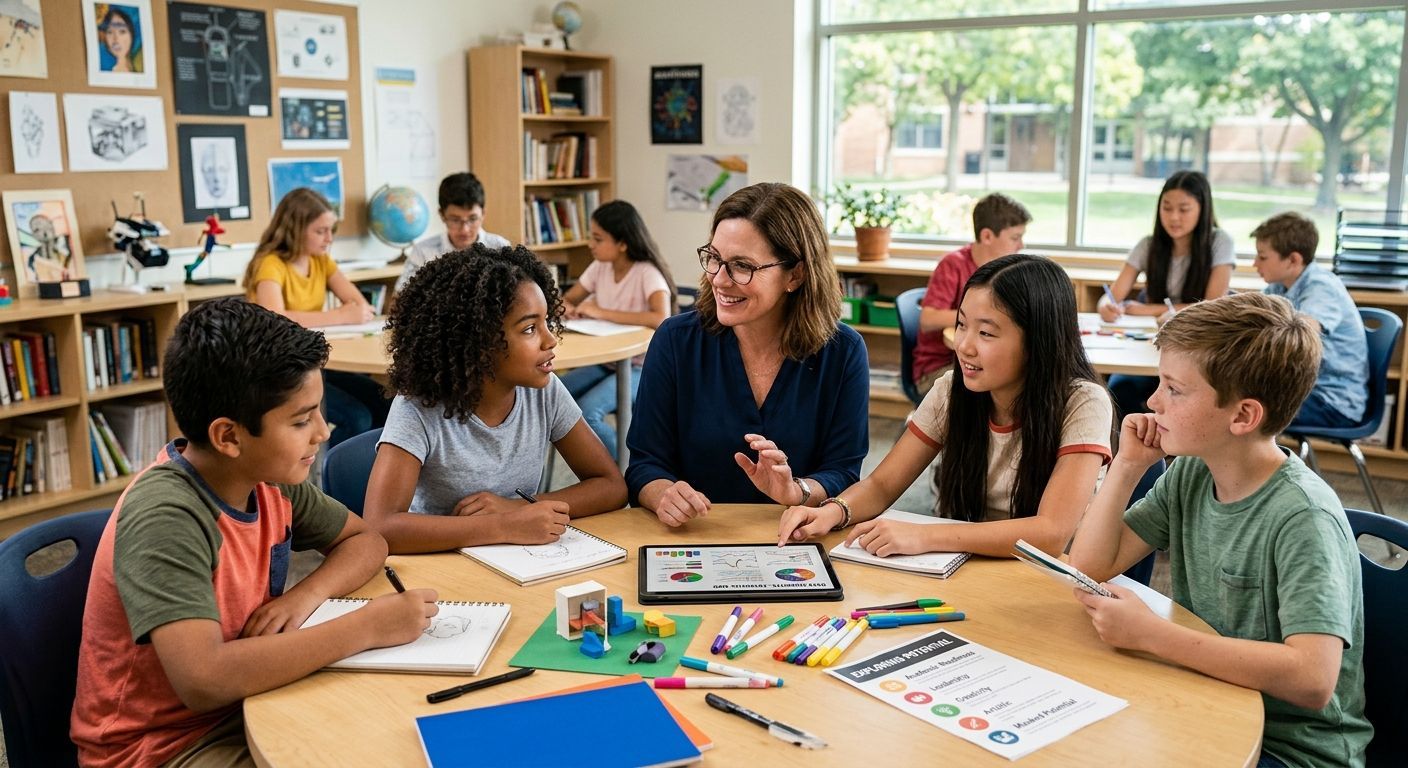
To expand our lens, consider asking:

  • Academic Readiness: What level of depth and complexity is this student ready for right now? Have we reached the ceiling of our standard classwork?
  • Leadership Potential: How does this student influence, organize, or direct peers? Do they display social intelligence, empathy, or strong task commitment during group work time?
  • Creativity Potential: How do they approach novel, open-ended, or ambiguous problems? Do they display flexibility, curiosity, or originality in their thinking?
  • Artistic Potential: Does the student demonstrate exceptional technical skill, emotional expression, or original spatial reasoning across non-traditional formats?
  • Masked Potential: Are there hidden strengths being masked by language acquisition, learning differences (twice-exceptionality), or behavioral friction?


Building a comprehensive profile is an ongoing process of inquiry: it begins with thoughtful questions, followed by intentional data collection. Because no single assessment can capture the full spectrum of a student's gifts, relying on a solitary test score inevitably leaves gaps. Pairing quantitative metrics with qualitative insights gives us the clearest picture. Resources such as the Department of Public Instruction's (DPI) list of Targeted Screeners, aligned directly with the Domains of Giftedness, offer excellent starting points. Collaborating with colleagues to select the right tool for each specific question ensures your inquiry remains targeted and manageable.


Broadening our assessment toolkit beyond subjective observation serves two crucial purposes:

  1. Mitigating Identification Bias: While teacher observations are invaluable, relying on them alone tends to favor high-achieving, compliant, or native-English-speaking students. Objective, varied data acts as an equalizer, illuminating the strengths of quiet, underrepresented, or twice-exceptional learners who might otherwise go unnoticed.
  2. Distinguishing Potential from Achievement: Strategic data tools help us separate high achievers (students who have mastered the current curriculum) from those who exhibit high readiness and potential (students who process concepts at an accelerated rate, think divergently, or possess latent talent).


As we continue to move through the school year, let's remember to ask the right questions.


- Mary Ann Hudziak, WATG Board Member

Recent Posts

By Laura Mukerji • September 11, 2026
Discover how early enrichment opportunities and museum visits help shape student identity, boost academic confidence, and drive long-term talent development.
By Dr. Sara Bolster • September 10, 2026
Discover key traits to identify gifted and twice-exceptional learners in September by observing curiosity, creative problem-solving, and non-traditional strengths.
By Keelin Eggleston • September 8, 2026
Help gifted learners avoid boredom and burnout by adjusting task complexity, adding constraints, and shifting perspectives instead of increasing work volume.
By Kris Lockhart • September 7, 2026
Learn how to use student data to differentiate instruction for gifted learners by adjusting classroom content, process, product, and learning environment.
By Jessica Barrington • August 31, 2026
Jessica Barrington debunks 8 GT myths on IQ, self-direction, and grouping, urging teachers to offer targeted guidance and meaningful daily challenge.
By Jackie Drummer • August 31, 2026
Jackie Drummer pairs the classic Eight Great Gripes with raw middle school voices. Explore their honest wonderings to spark meaningful student dialogue.
By Jenna Cramer • August 31, 2026
Is giftedness part of neurodiversity? Dr. Jenna Cramer explores differing perspectives, 2e complexities, and why clear terms matter for student support.

By Jennifer Neuman • August 6, 2026
Help gifted learners build executive function skills! Discover strategies for parents and teachers to manage task paralysis and organization.
By Dr. Sara Bolster • July 30, 2026
Dr. Sara Bolster shares 4 actionable back-to-school strategies for parents to manage "August Anxiety," perfectionism, and executive function in gifted kids.
By Guest Author • July 29, 2026
Learn how Adverse Childhood Experiences (ACEs) conceal giftedness in underrepresented students with expert Dr. Pamela J. Pine.
Show More